Thursday, January 10, 2019

Anne of Cleves -


  Anne was the fourth wife of Henry VIII and was able to survive his beheading obsession and go on to live a full life. 

  Anne's father was duke of Cleves (German: Kleve) and her mother was the daughter of the duke of Julich, which means she was pretty well connected in Germany. Where the heck is Cleves anyway? Cleves was a duchy located on the Lower Rhine region of northwest Germany near the Dutch border. Cleves had been an important town since the 11th century and became a duchy in 1417. Her father John established Lutheranism throughout his duchies so it makes sense that she would be proposed as a possible match to the king who brought Protestantism to England.

  Anne was born on 22 September in 1515 in Dusseldorf, Duchy of Berg. She was 24 and Henry was 48 when they married on the 6th of January in 1540 at the Palace of Placentia in Greenwich, London. Henry objected to the marriage and tried to find a way out of the betrothal contract but no one could find a way to end it. He told Cromwell on the day the marriage took place that "if it were not to satisfy the world and my realm, I would not do that which I must do this day for none earthly thing." So, why did Henry agree to marry her in the first place? He needed political Protestant allies. So, why did Henry become so against the marriage? Who know? It's Henry VIII. Actually there were a few reasons, though they might not make much sense to us.

  While marrying site unseen to make political alliances was totally the norm back in Henry and Anne's time, this idea did not appeal to Henry. He preferred to prowl on his own to find a wife he desired. He asked for a painting of Anne so that he might know what she looked like. Being put off by Anne's people, Henry sent his own painter to Cleves to paint a portrait of Anne. Henry wasn't keen on the marriage idea after seeing her portrait but was convinced to carry on because of the Protestant alliances that was to be made. 


Portrait of Anne of Cleves by Hans Holbein the Younger commissioned by Henry VIII
  Henry contrived to meet Anne by surprise as she made her way to London. The first time they met he was in disguise. Henry loved to disguise himself to see if people could see through his costume. His true love surely must be able to see the man behind the mask. Unfortunately when Anne met Henry in his disguise she did not instantly recognize him as her true love. Accounts of this first meeting say that Henry embraced and kissed her and presented her with New Year's gift from the King. Anne, not knowing who he was, rejected him and pushed him away. This was a great disappointment and turn off for Henry. No true love for him with Anne.

  Even though Henry thought Anne "well and seemly," she was not the great beauty that she had been reported to be and her appeal grew less and less. She did not speak English and was uneducated. This was another turn off for Henry who liked his women smart and witty. He was reportedly so repulsed by her looks that after four days of marriage their union had still not been consummated. Anne described their nightly ritual to one of her ladies in waiting saying he would take her hand, kiss her and wish her a good night and would leave the same way in the mornings. On July 9th, six months after their marriage took place it was unanimously declared null and void by Parliament. 

  The fact that Anne kept her head figuratively through all of this drama is why Henry allowed her to keep her head literally. She had been made aware of Henry's plans to annul the marriage from a letter sent by him in June. At first she was upset and fainted, but after giving it some thought and consulting with her clergy, she was satisfied with the arrangement. I mean, who wouldn't be? She got to remain with the living, with an attached head and was granted lands worth £4,000 a year. All Anne had to do was renounce the name of Queen of England for that of the King's "sister" and stay in England the remainder of her days.

  So what did Anne think of Henry, their brief marriage and her life in England after the annulment? We don't know much about her thoughts and actions before coming to England. She did convert from Lutheranism to Anglican when she arrived in England. Since Anne had no education she was probably very innocent and naive but the fact that she accepted Henry's wishes for an annulment shows she certainly wasn't stupid. After their marriage was annulled, Anne became an honorary member of Henry's household and was invited to court often. She reported that the King was always kind to her. Henry was so grateful she didn't make a stink over the dissolution of their marriage that he decreed she had precedence over all other women at court except for his wife and daughters.

  When Henry's daughter by his first wife ascended to the English throne as Mary I, Anne of Cleves rode beside Mary's sister (and future Queen) Elizabeth in the coronation procession. Anne once again changed her religion, this time becoming Catholic since Mary I was a Catholic herself. Anne eventually fell out of favor with Mary because of her close connection to Elizabeth and Mary stopped inviting her back to court.

  Anne died at Chelsea Manor in July of 1557, just eight weeks before her 42nd birthday. In her will she asked Mary and Elizabeth to employ her servants. She also left some money for her servants who described her as generous and an easy-going mistress. She was buried on August 3rd in Westminster Abby and is the only wife of Henry VIII to be buried there. 


For further reading on King Henry's probably least known wife check these books out:

Anne of Cleves: Fourth Wife of Henry VIII - Mary Saaler

Anne of Cleves: Henry VIII's Discarded Bride - Elizabeth Norton

The Marrying of Anne of Cleves. Royal Protocol in Early Modern England - Retha Warnicke


Friday, March 23, 2018

Fashion Friday! The Chemise


che·mise
SHəˈmēz,SHəˈmēs
noun
  1. a dress hanging straight from the shoulders and giving the figure a uniform shape, popular in the 1920s.
    • a woman's loose-fitting undergarment or nightdress, typically of silk or satin with a lace trim.
    • a priest's alb or surplice.


  2. Today we take a look at an article of women's clothing known as the chemise or the shift. 

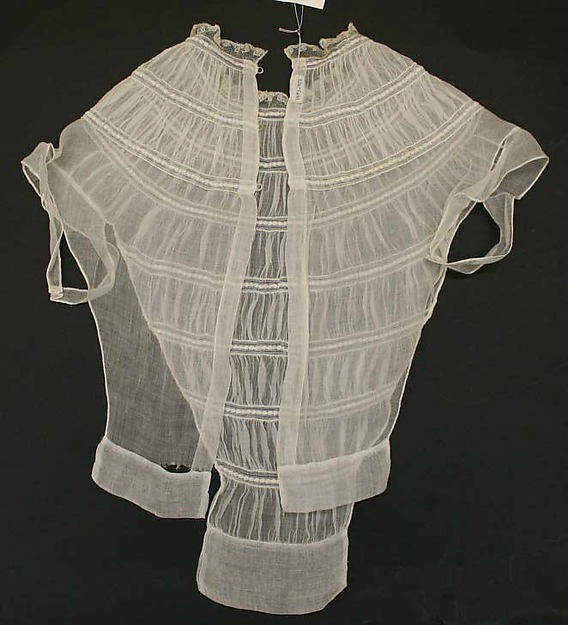
The Chemise most likely evolved from tunics which were garments worn by Greco-Roman men and women as well as Celtic men and women. Originally called a smock by the Saxons, the term became interchangeable with chemise, a Norman (French) word for a man's shirt. The word shift was used also but was considered a vulgar term used by lower classes. It was a loose fitting garment typically knee length worn next to the skin to provide a layer of protection to outer clothing from body oils and sweat. This helped to keep outer garments lasting longer since it reduced the need for washing.They were also worn as night gowns. Wealthy women might own several shifts, while poor, working or country women may have only owned one.

Materials used for the chemise varied from fine linen, holland, and cambric to cotton, and silk. Depending on the neckline of the dress, the chemise could have a high neckline with embroidery, lace or ruffles, or a low neckline that was not meant to be seen. They were almost always white. Sleeve and hem length also varied as the style of women's dress changed through out history. Some extant examples show bobbin lace or embroidery all the way down to the waist or along the seams to act as reinforcement. Sometimes they were heavily perfumed to help cover body smells or the smells from the laundering process.


Related image
                                                                                    Chemise pattern 

The chemisette was a "little chemise" used to fill in the neckline of a gown without the added bulk of a full chemise. 

Image result for chemisette
                                                                                       Chemisette

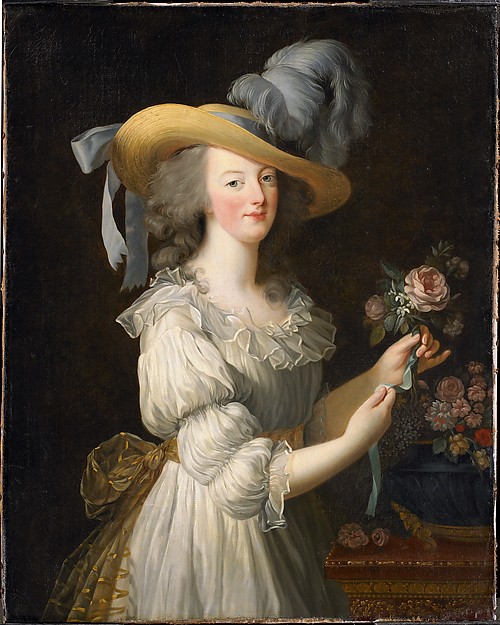
Queen Marie Antoinette of France shocked genteel society by allowing herself to be painted in a Chemise dress. This dress, also called chemise a la reine or gualle, was such a contrast to the normal attire of constricting, large hooped dresses worn at the French court. These dresses were made of light, gauzy muslin, tied with a sash around the waist and gave the impression that the wearer was in hardly more than her undergarments! These dresses were so thin that they garnered the nickname the Influenza Dress.

Marie Antoinette in a Chemise Dress, Élisabeth Louise Vigée Le Brun (French, Paris 1755–1842 Paris), Oil on canvas
                 Marie Antoinette in Chemise Dress Oil on canvas 1783 Élisabeth Louise Vigée Le Brun

The chemise took on many styles such as the princess chemise, or the empire chemise with a sloping front waist and puffy short sleeves. In 1877 a new style of combining a chemise and drawers together came on the fashion scene making the basic chemise outmoded. This garment could have a back or front opening and were worn to obtain the desirable female figure. By the mid 1900's the chemise was shortened into a vest-like garment but retained its original name. Also by this time it was no longer being worn as sleep wear. Separate garments known as pyjamas were the commonly worn clothing attire to sleep in.  

Today a modern chemise is still typically an unfitted, loose flowing women's undergarment. Chemise dresses are still in fashion as well and basically have the same form and function.
Image result for chemise


Further reading:

The History of Underclothes - C.Willett and Phillis Cunnington

Clothing Through American History: The Federal Era -Antebellum 1786-1860 - Ann Buermann Wass and Michelle Wenn Fandrich


Sunday, March 1, 2015

Suffragettes of Tennessee

"Bullets and ballots are not companions, but ballots in the hands of people are supposed to be a substitute for bullets in the hands of hired agents...Thanks be to God that in giving women the crown of motherhood he made her the giver not the taker of life. Woman has no greater claim to the rights of the ballot than she is a producer not a destroyer of life." - Lizzie Crozier French


                                                       Suffrage Poster


Everyone knows of the tireless efforts of women like Susan B. Anthony, Alice Paul, Lucretia Mott, Carrie Chapman Catt and Elizabeth Cady Stanton in their fight for the right for women to vote. Their names have become synonymous with Women's Suffrage. Few people have heard of these remarkable Tennessee women that helped convince the Tennessee Legislature to ratify the Susan B. Anthony bill; known today as the 19th Amendment to the Constitution. 

 In order for an Amendment to pass and become law it has to pass through both houses of Congress and then be ratified by a majority of 36 states. In 1919, the 19th Amendment passed through both houses of Congress. Six states ratified the bill immediately. Twenty nine states soon followed suit while six Southern states rejected it. Florida, North Carolina, Vermont, Connecticut, and Louisiana opposed the Amendment. The last two states to decide were Delaware and Tennessee. When the bill was defeated in Delaware every breath was held and every eye turned to Tennessee. 

                                                  Anti-Suffrage Poster


Tennessee had it's own "War of the Roses" as anti-suffragists campaigned using a red rose to symbolize their stance and suffragists choosing a yellow rose. Nashville was flooded with campaigners and lobbyist. On August 9, 1919 a special session of the Tennessee General Assembly was called; requested by Sue Shelton White. The bill finally passed the Senate on Friday, Aug. 13 by a margin of 25-4 with one senator abstaining. The bill was then handed off the the House where it was debated for three more days. A test vote to table the resolution lost on a 48-48 tie and, knowing another tie vote would defeat the bill  an anti-Suffragist immediately called for another vote to kill the amendment in Tennessee. Rep. Harry Burn, after having just received a letter from his mother urging him to ratify, voted "Aye" to the resolution The bill now had a 49-47 majority in the Tennessee House of Representatives.  On August 18, 1919, Tennessee certified the ratification, becoming the 36th state to do so and making the 19th Amendment to the United States Constitution the law. Women everywhere celebrated their win. They now had the right to vote! 


Tennessee was an important factor in deciding the fate of American Women and so were these ladies that you, dear readers need to know about. There were many women in the state that came together to make their voices known. History has not left us with the names of every Tennessee suffragist but we remember their collective effort to support the cause. Now I would like to introduce you to the following remarkable Tennessee Suffragettes.


                     The Tennesee Woman's Suffrage Memorial depicts Lizzie Crozier French, Anne Dallas Dudley, and Elizabeth Avery Meriwether. The three women represent the three different regions of Tennessee. It is located in Market Square Mall, downtown Knoxville, TN


Anne Dallas Dudley 
"Every reform is started by a minority."
Anne was from a wealthy family in Nashville. Anne Dallas Dudley, daughter of Trevanion Dallas, a wealthy cotton mill owner, and great niece of George Dallas, who was James K. Polk's vice president.  She was a strong believer in the Woman's Suffrage Movement. Anne shocked all of the Nashville elite by organizing the first suffrage parade not only in Nashville, but in the South. Sixty automobiles, decorated with yellow banners, paraded from the Capitol to Centennial Park. To counter the criticism that suffragists ignored their families, Anne Dallas Dudley was joined in the lead car by her husband, Guilford Dudley, co-founder of Life & Casualty Insurance Co., and their children. She helped found the Nashville Equal Suffrage League in 1911 and convinced Susan B. Anthony to hold the national conference for her American Woman Suffrage Association at the Ryman Auditorium in Nashville. In the 1930s Dudley served as president of the Maternal Welfare Organization of Tennessee. This group brought birth control pioneer Margaret Sanger to Nashville in 1938 to increase public awareness of birth control. She is buried at Mt. Olivet Cemetery in Nashville.


Sue Shelton White
"We should be ashamed to stand on ground won by women in the past without making any effort to honor them by winning a higher and wider field for the future."
"Miss Sue" as she was called, was born in 1887 and grew up and lived in Henderson, a suburb of Nashville. Unlike most suffragettes, her parents were both teachers and they lived very modestly. Left an orphan at the age of 14, Sue vowed to pursue an education so she would not become anyone's financial responsability. She moved in with her aunt and enrolled in George Robertson Christian College and then went on to study at West Tennessee Business College. In 1907, Sue became one of 
the first female court reporter in Tennessee. In 1912, while living in Jackson, TN, Sue became a founding member of the Jackson League of the Tennessee Equal Suffrage Association (TESA) and was elected recording secretary the following year. She wavered back and forth between the two different Suffrage organizations; the NAWSA (The National American Woman's Association) and the NWP(National Woman's Party). She was elected chairwoman of the Tennessee chapter of the NWP after breaking ties with the NAWSA for good. In 1919, she was elected as editor of the NWP;s newspaper Suffragist. After the radification of the 19th Amendment which finally gave women the right to vote, Sue moved to Washington. D.C. to pursue a law degree. In 1923 she recieved her degree and was admitted to the Bar. She continued to fight for women's equality and helped draft the Equal Rights Amendment. In 1926, Sue moved to Jackson TN and became the city's first female lawyer. Sue is the only known female Tennessean who was jailed for her participation in the suffrage cause. She was a member of the NWP protest party that burned an effigy of President Wilson in front of the White House. She died in 1943 from cancer.

Lizzie Crozier French 
Lizzie Crozier was born in Knoxville on May 7, 1851 to Congressman and local attorney John H. Crozier. While little information is known about her mother, Lizzie was one of three girls born into the family. Lizzie was educated at the Convent of Visitation at Georgetown in Washington, D.C. and at a private Episcopal School in Columbia, TN. Lizzie married William French at age 21 and together they had a son. William died after only two years of marriage and Lizzie took a teaching position at the Knoxville Female Academy. In 1885, Lizzie French, along with her sisters Lucy and Mary founded a school for "young ladies and children" at the Knoxville Female Academy, where the sisters developed an educational curriculum that taught children more than just the basics of reading and writing. They did so well that the school became known throughout the city and was one of the most popular among parents and students for its approach to education. 
On Nov. 20 of that same year, French invited 12 women to the Knoxville Academy to organize a literary group like the one she had visited while traveling in New York. The 12 women who chartered the organization that night chose the name the Ossoli Circle. In 1896, French founded the Women’s Educational and Industrial Union and used her position in the organization to become the first 
woman to address the Knoxville City Council appealing for the appointment of a Police Matron– a female police officer for women offenders who would assist in the care and treatment of the females arrested by police. She convinced the City Council of the need for one and filled the position herself for several months until the city could hire someone permanetely. She then became the first woman to address the Tennessee General Assembly, lobbying on behalf of efforts to establish a separate prison for women and children in the state of Tennessee, which led to the establishment of both institutions. In 1912, Lizzie was elected president of the Tennessee Suffrage Association. She also became the first woman to address the Tennessee Bar Association. French continued her work in Knoxville founding and serving as president of the Knoxville Equal Suffrage Society and becoming a leading member of the National Women’s Party(NWP). On Aug. 9, 1919, the special session of the Tennessee General Assembly was called to order. Lizzie, then 68 years old, was there using her voice. Lizzie remained an active member of the Knoxville community and made a bid for City Council in 1923, but was defeated. Three years later, at the age of  75, she traveled to Washington, D.C. to help the National Women’s Party furnish a room in honor of the Tennessee suffragists and also secure introduction of a bill in Congress to benefit working women in America. On May 14, 1926, while still in D.C., the Tennessean quietly passed away. Her body was returned to her hometown in Knoxville where she was laid to rest in the city’s Old Gray Cemetery.


Elizabeth Avery Meriwether
 “But when will women have the right to vote?  I have been taught to believe that taxation without representation is tyranny.”
Elizabeth was born in Bolivar, TN in 1824. Her father was a Quaker physician and her mother was the daughter of a Virginia planter who had moved to Tennessee. Elizabeth's parents died when she was 22. She and her siblings lived in poverty until her brother Tom finally received his law degree. In January 1850, Elizabeth married Minor Meriwether, a civil engineer. He later joined the Confederate Army to fight for the South in the War Between the States. Elizabeth found her name on a list of outspoken Confederate officer's wives who were to be removed from their homes near Memphis or face arrest and incarceration. Elizabeth had two small children and was pregnant with her third. She attempted to follow her husband's unit, and delivered her third child in a stranger's house on Christmas night in 1862. She resorted to stealing corn for food for her children, selling clothing and even sneaking back into Memphis on a dangerous mission to pay taxes so her property would not be sold at auction. She eventually ended up in Tuscaloosa, Alabama. During this time she began writing stories and selling them to newspapers. After the war Minor Meriwether purchased a modest Memphis home for his family on the current site of the Peabody Hotel. Elizabeth petitioned occupation forces under Union General Stephen A. Hurlburt, in an effort to regain title to her girlhood home which had been confiscated by the Union during the war, and was finally successful. Thus recognized as a property owner and tax payer, she obtained a voter registration in 1872. In 1876 she went to the polls and attempted to vote in the presidential election of that year. (At this time I have not verified whether she was actually allowed to vote. It was rumored that they dropped the ballot in the box to keep her happy and then destroyed her ballot later. ) She was one of the first women in the state to publicly push for women's suffrage in the early 1870s. She wrote letters to newspapers and published a pamphlet about women's rights. For a year, she published a small newspaper, The Tablet, which showcased her views on women's issues, divorce law and equal pay for women teachers. In 1876 she made one of the first public suffragist speeches in Memphis. She was active in the Women's Christian Temperance Union and belonged to the National Woman Suffrage Association, and presented unsuccessful women's suffrage petitions at both the Democratic and Republican national conventions in 1880. In 1881, Meriwether joined Elizabeth Cady Stanton and Susan B. Anthony on a speaking tour. She also continued to write, publishing several books. In the late 1800s, the Meriwethers moved to Saint Louis, Missouri where they built Meriwether Mansion. Just before her death on November 4, 1916, Elizabeth wrote her memoirs entitled Recollections of 92 years. She did not live to see the 19th Amendment become law. She is buried in  Bellefontaine Cemetery in St. Louis.


                                                                 Suffrage Parade


Mary Cordelia Beasley Hudson
Mary was the first woman to legally vote in Tennessee. Mary was born in Benton, Co. TN on August 1, 1851. She was the daughter of Reuben Beasley and Elizabeth Brown.  On January 9, 1872, she married O. B. C. Hudson in Benton County.  She and her husband had six children and operated a grocery store near their home in Camden, TN. On April 5, 1919, the Tennessee General Assembly passed a limited suffrage act. Governor Albert H. Roberts signed the suffrage bill into law on April 17, 1919.  A few days following this, on Tuesday, April 22, a municipal election was held in Camden.  Mrs. Hudson, who had joined the suffrage movement in 1918, cast her vote and was quick to point out that she voted for the winner of the election, A. V. Bowls. I have not been able to find out much more than this but I will continue to research.


Further Reading:
The Woman Suffrage Movement in Tennessee - Antoinette E. Taylor
More than Petticoats: Remarkable Tennessee Women - Susan Sawyer
The Perfect 36: Tennessee Delivers Woman Suffrage - Carol Lynn Yellin and Janann Sherman
Recollections of 92 Years - Elizabeth Avery Meriwether
One Woman, One Vote; Rediscovering the Woman Suffrage Movement - ed. Marjorie Spruill Wheeler. Troutdale, OR: NewSage Press 1995
Votes for Women!:The Woman Suffrage Movement in Tennessee, the South, and the Nation - Knoxville, TN: University of Tennessee Press 1995
http://tennessee.gov/tsla/exhibits/suffrage/beginning.htm
National Women's History Museum

Saturday, February 7, 2015

Laura Ingalls Wilder


Laura Elizabeth Ingalls was born February 7th, 1867 in Pepin, Wisconsin to Charles Ingalls and Caroline Quiner. Most of her life was recounted in her famous "Little House" books which were adapted into a T.V. show in the 1970's.  She was the second of four children. In 1874, the Ingalls family left Wisconsin for Walnut Grove, Minnesota, where most of the T.V. series takes place. Two years later, the family moved to Burr Oak, Iowa, where her father became part-owner of a hotel. But the hotel business must not have been too lucrative because the family moved back to Walnut Grove a year later. In 1879, Laura's family moved again to the Dakota Territory.

Laura's father built a homestead in De Smet, South Dakota. Both Laura's parents lived there until they died and the house that "Pa" built is still standing and open for tours.  In 1882, at the age of fifteen, Laura received her teaching certificate. This is when she met/courted Almanzo "Manly" Wilder, the man she would spend the rest of her life with.  For the next three years, Laura taught at a small country school several miles from her home in De Smet and boarded with a family who lived nearby. Almanzo began coming to pick Laura up from school every Friday to take her home to her family, and every Sunday he would bring her back to the family she was boarding with while teaching. Thus began Laura and Almanzo's courtship.

Laura and Almanzo were married on August 25, 1885 in a very simple ceremony at the local Reverend's house in De Smet. Laura quit her teaching job to help Almanzo work their farm. The following year, on December 5th, 1886, their daughter Rose was born. In August of 1889, Laura gave birth to a boy that would not survive infancy. 

The Wilders moved to Mansfield, Missouri in 1894, where they built a farm they called Rocky Ridge. Here, Laura would write her famous "Little House" books recounting her life growing up. Here, Laura and Almanzo would both die. Laura wrote her first book, an autobiography titled "Pioneer Girl", some time in the late 1920's but no one would publish the work.  This work has recently been published by the South Dakota State Historical Society. She decided to change the autobiography from a first person point of view to third person and broadened the story to include more of her family and neighbors. She also geared it towards children. In 1932, the first of the "Little House" books was published. Laura was sixty five years old. Seven more "Little House" books would be written and published. Laura passed away at her Rocky Ridge home on February 10, 1957. She was ninety years old. You can also tour this home.

Laura Ingalls Wilder left a great legacy for all of us to share. How many of us read her books as children? How many of us grew up watching the television adaptation of her books? She made the struggles and harsh realities of living in the western frontier of the United States in the late 1800's real to many people, but she also let us share in the love that her family had for each other.

Did you know?
Did you know that Rose Wilder Lane was the last direct descendant of Charles and Caroline. Laura's sisters never had children of their own. Mary never married, Carrie married when she was in her forties and Grace never had children with her husband. Rose married when she was in her twenties but the marriage didn't last long and there were no children produced.

Further reading:
West from Home: Letters of Laura Ingalls Wilder to Almanzo - Laura Ingalls Wilder
Pioneer Girl - Laura Ingalls Wilder
Laura Ingalls Wilder: A Biography - William Anderson

http://www.notablebiographies.com/We-Z/Wilder-Laura-Ingalls.html

http://www.discoverlaura.org/index.html

http://www.lauraingallswilderhome.com/

Sunday, February 1, 2015

Lydia Bean

Lydia (Russell) Bean was born in 1726 in Rappahanock County, Virginia. She was the daughter of Lt. Col. William James Russell and Martha Graydon. In 1741, Lydia married William Bean, a friend and traveling companion of Daniel Boone. Lydia and William had 10 children. They moved from Virginia in 1769 to what would later become the state of Tennessee. Their first born son Russell was born the same year and is reported to be the first white person born in Tennessee.

Lydia was captured in July 1776 by hostile Cherokee Indians prior to an attack on the Wataugu settlement. The Watauga settlement was located south of the Holston River, on the Watauga and Nolichucky Rivers in the colony of North Carolina, now Tennessee.  She was intercepted as she made her way from her home on Boone’s Creek to Sycamore Shoals. She was sent to the Overhill Towns, a Cherokee village, and was sentenced to execution. She was actually being tied to a stake when Nancy Ward, Beloved Mother of the Cherokee, exercised her right as a woman of the tribe (the women usually decided the fate of captives) to spare Lydia from death. She took the injured Mrs. Bean into her own home to nurse her back to health. In return Lydia taught Nancy and the other women of their tribe many new and useful ways of the white man, and it is said that Lydia was the one who introduced cows into Cherokee society by giving some of her own cattle to Nancy Ward.

Several members of the Bean family were killed by hostile Indians, including a brother and one of her daughters. Lydia herself lived to be 62 years of age and she died on June 18, 1788 in Grainger County, Tennessee.


The introduction of European ways into Nancy Ward's tribe by Lydia Bean helped to effectively change the gender dynamics of Cherokee society. The men began to take the place of women as farmers while the women were expected to do common white women's chores such as making clothes and making butter and cheese.


                       Historical Marker at the location of Bean's Station, a stopping point for travelers


                                          Historical Marker for the Bean family cabin


Further research:
Bean Family Genealogy

Bean Station

Annals of Tennessee - J.G.M Ramsey

Sunday, November 16, 2014

Mary Lacy: Female Shipwright

Mary Lacy was born on January 12, 1740, at Wickham in Kent, England. She was the oldest of three children and was sent to a charity school to be educated. She went into domestic service around the age of twelve and worked as such for seven years. During this time, she fell in love, which went unrequited, and she decided to leave her home and place of service. In May of 1759, at age nineteen, she traveled to the dockyards of Chatham, disguised herself as a man and using the name William Chandler, enlisted in the British Royal Navy aboard the 90-gun ship Sandwich. Mary, now known as William, became servant to the ship's carpenter, Richard Baker.

During this time England was fighting France in what is known as the Seven Years War in Europe and the French and Indian War in America. During the 1759-1760 year of the war, the HMS Sandwich helped patrol the seas off Ushant and Biscay Bay as a blockade ship against the French.

Mary Lacy rolled with the waves and adjusted to life aboard ship. She suffered a few bouts of sickness due to rheumatoid arthritis. At one time she was confined to the sick bay for several weeks and one episode was so severe that she was sent to the naval hospital in Plymouth. By the time she recovered, the Sandwich had already sailed without her. She then joined the crew of the HMS Royal Sovereign, a 100-gun ship that was permanently stationed offshore at Spithead and used to guard the port.   

Mary decided she wanted to become a shipwright's apprentice. In March 1763, she was signed on as apprentice to Alexander McLean, the acting carpenter of the Royal William, which had been decommissioned and was based at Portsmouth Dockyard. Mary completed her apprenticeship in 1770 and was certified as a shipwright.

Mary wrote an autobiography but never really talked about the difficulties in keeping up her disguise as William Chandler. Her sex was almost discovered when she tripped while working on the deck of the Royal Sovereign and fell down an open hatch. Her head was badly cut and she had to be taken to the doctor. In her autobiography she recounts her close call.


When I came to myself I was very apprehensive lest the doctor in searching for bruises about my body should have discovered I was a woman, but it fortunately happened that he being a middle-aged gentleman, he was not very inquisitive, and my messmates being advanced in years, and not so active as young people, did not tumble me about or undress me.


The ladies were very fond of William Chandler, which is lucky for Mary because it probably saved her from being found out. Lacy had written to her parents all about her adventures. A family friend (who maybe wasn't such a good friend after all), was let in on her secret and began spreading rumors around the shipyard where Lacy now worked. Two of the shipwrights that she worked for as an apprentice took her aside and demanded the truth. She broke down and admitted she was in fact a woman. Out of respect for Mary, these men swore to keep her secret and convinced everyone else in the dockyard that Mary was indeed a man, siting her interest in so many ladies as evidence.

Some time after receiving her shipwright certificate, Mary hurt herself while helping dismantle a ship. She realized that she could no longer perform her job and had no other option but to apply for a disability pension from the Admiralty. Her case was approved by the Lords of the Admiralty on January 28, 1772.  Below follows the report as it was recorded in the Admiralty minutes:


A Petition was read from Mary Lacey setting forth that in the year 1759 she disguised herself in men's clothes and enter'd on board His Majesty's Fleet, where having served until the end of the war , she bound herself  apprentice to the carpenter of the Royal William and having served seven years, then enter'd as a shipwright in Portsmouth Yard where she has continued ever since; but that finding her health and constitution impaired by so laborious an employment, she is obliged to give it up for the future, and therefore, praying some allowance for her support during the remainder of her life;
                       Resolved, in consideration of the particular circumstances attending this woman's case, the truth of which has been attested by the Commissioner of the Yard at Portsmouth, that she be allowed a pension equal to that granted to Superannuated Shipwrights.
Nothing much is known about Mary Lacy's later life. Her autobiography suggests that she married a Mr. Slade, a man that she met in Deptford. David Cordingly, author of Women Sailors and Sailor's Women, theorizes that the happily ever after future depicted at the end of Mary's story was added by her publisher so that the story would have a more traditional end to balance out all the suggestions of lesbian flirtations. 


Further readings:

Women Sailors and Sailor's Women - David Cordingly

The History of a Female Shipwright...Written by Herself - Mary Lacy

Friday, November 7, 2014

Fashion Friday! The Spencer Jacket

I am finally back with a new blog and it's Friday; which means it's Fashion Friday!

I am in the process of putting together an outfit inspired by Jane Austen and the Regency Period of Fashion. Included in my outfit will be what is known as a Spencer, or Spencer Jacket.

The Regency Period of Fashion refers to the time period in England when Prince George was acting as Regent after his father King George III went insane in 1811.


The Spencer is named for George Spencer, 2nd Earl of Spencer (1758-1834)  The Earl supposedly stood a bit too close to the fire one day and singed the tails of his coat. He then had the tails of his coats trimmed and thus a new fashion was born. It was first worn by men in the 1790's and was usually trimmed with a military style decoration with braids and frogging.
                                                                   The Honorable 2nd Earl of Spencer by John Singleton Copley


Women's dress at this time was starting to shift to what is known as the "Empire Style" of dress. Their dresses were made from thin, lightweight material, usually Muslin, and often had short sleeves; even in winter. The Spencer was found to be a very serviceable garment to ward off the chill. 

"My kerseymere Spencer is quite the comfort of our evening walks." - Jane Austen 1808

It was a short, close fitted jacket, coming to just above the waist line with a high collar, and was usually made from a wool material known as kerseymere, or from velvet. As the waist line began to move down again in the 1820's-30's, the Spencer also moved down to follow the waist. They could button closed or could be worn open like a cardigan would be worn today. Military decor was still used on the female version of the Spencer as a way to add interest to an otherwise mundane and boring (most often all white or a very light color) dress. 

Spencers were so versatile and useful (unlike most of the clothing of the time) that they remained in fashion until the second decade of the nineteenth century. As fashion began to change once again the Spencer fell out of high fashion and thus into history.

I especially LOVE this particular Spencer sewn by American Duchess


For further reading/research on the Spencer or fashion in general, I suggest:

Fashion in the time of Jane Austen - Sarah Jane Downing

An Introduction to Ladies' Fashions of the Regency Era - Lord Scot

http://www.fashion-era.com/index.htm

http://historicalsewing.com/

There are also TONS of Pinterest boards!