Monday, February 10, 2020

Eleanor of Aquitaine

In today's blog post we will learn about one of my favorite female historical figures.
A ruler in her own right to the Duchy of Aquitaine, this woman would become queen of two countries and mother to two kings of England. She went to war, made war against her own husband, and was locked away in a tower. The Woman, the Myth, The Legend: Eleanor of Aquitaine.

Aquitaine, a very rich and fertile land, is a region in southwestern France. It's name possibly originated with the Romans and their Latin word aqua, meaning water, since it boarders on the Atlantic Ocean. At one point in it's varied history Aquitaine was declared it's own separate Kingdom when Emperor Charlemagne bestowed the title of King of Aquitaine on his son Louis. After a while the kingdom fell apart and reverted back to a Duchy. Aquitaine grew into one of the most cultured courts in all of Europe. Eleanor's grandfather is touted as being the very first troubadour and the ideas of chivalry and "courtly love" supposedly developed in Aquitaine.  Eleanor came from a long line of Dukes that had ruled over Aquitaine since the year 835 when the Ramnulfids led by Ramnulf I of House Poitiers took control over the lands. 

Eleanor's early life remains unknown to us. Her name was originally spelled Alienor. Named after her mother, it meant "the other Aenor." She was schooled in housekeeping and needlework, but because of the urbane and sophisticated court at Aquitaine she was probably highly educated in reading, writing, languages, poetry, music, dance and a musical instrument or two. We have no factual evidence of what she looked like. No descriptions of her eyes, hair color or stature have been left for us. Even Eleanor's specific birth date is unknown but historians believe she was born either in 1122 or 1124. This would make her between 13-15 in the year 1137 when her father William X Duke of Aquitaine passed away. Eleanor's brother and the only son of William X and Aenor had died some years earlier leaving Eleanor, as the oldest daughter, heir to the Duchy of Aquitaine. Since Eleanor had not yet reached the age of maturity her father had asked Louis VI, King of France to become her guardian. Louis saw a golden opportunity to gain some of the most fertile lands in all of France and he quickly betrothed his young ward to his son and heir, sixteen year old Prince Louis. However, France would only benefit from Aquitaine so long as Eleanor remained married to Louis. The land was hers by right of inheritance and would remain in her name. 

The Prince traveled to Aquitaine in the accompaniment of 500 knights to meet his bride. On July 25, 1137 in Bordeaux's Cathedral of Saint Andre, Eleanor and Louis were wed. After their wedding they traveled to Poitiers, the capital of Aquitaine, where they were crowned Duke and Duchess of Aquitaine. Louis VI, King of France had passed away during their travel from Bordeaux to Poitiers. After their coronations in Poitiers they rushed to Paris to make sure Prince Louis' right to the throne wasn't questioned. Eleanor, a young girl not yet sixteen, became a duchess in her own right and Queen of France all within the span of a few months.

It is generally believed that King Louis was so besotted with the bold and spirited Eleanor that he would do anything for her. He went to war against several important French dukes to gain lands that Eleanor felt should have belonged to her, he spent lavishly and even went against the Pope when Eleanor urged him to take her sister's side in a forbidden romance. Louis had originally been meant for the church and so was a very pious and cautious person. It does seem that for whatever reason he did have a bit of a personality shift after his marriage to Eleanor. Was Eleanor so charming and persuasive that she convinced Louis to go against his own character? Was he so in love with her that he would do anything she wanted; so enraptured that he took her with him when he went to fight in the Crusades? Possibly. But they eventually had a falling out and divorced so I feel this view is slightly exaggerated. Was she just a big nag and he did these things to shut her up? Possibly. I'm sure if we looked closely enough at the political gains that were to be gained from some of his decisions we would see it had more to do with continuing to build a reputation for France than for any crazy love he felt for Eleanor.

Eleanor gave birth to their first child, a daughter they named Marie, in 1145. The next year they both "took the cross" and made plans to fight in the Second Crusade to keep Jerusalem safe from the Turks. It is worth noting that Eleanor took the cross under her title of Duchess of Aquitaine and not Queen of France. This way the barons of Aquitaine who weren't loyal to Louis but were loyal to her would be bound to join the Crusade. Not many people wrote first hand accounts of the Crusades and even fewer wrote about Eleanor's part so we must take rumors, innuendos and implications with a grain of salt. Eleanor brought with her a train of ladies in waiting (some later accounts report at least 300 women), servants and baggage. Here is where Eleanor as a legend begins to take shape.  A Greek historian writing some 50 years after the Crusade described Eleanor and her ladies as wearing armor and riding astride their horses like men. He compared them to Amazons and thus a legend was born. Here was a woman already famed for her beauty, boldness, quick wit and adventurous nature. Being compared to the Queen of the Amazons only heightened her fame and appeal.  

Unarguably the undertaking of this Second Crusade is where her relationship with Louis, already fragile due to lack of a male heir, began to fall apart. No doubt the pious King of France took his role in the Crusade seriously. But what about Eleanor? Maybe not so much. Can you just imagine the scene of the procession as she rode into Constantinople and Antioch with her 300 women dressed to impress with armor and all the splendors of royalty. I think Eleanor viewed the Crusade as one lavish party and not the bloody, deadly war that it actually was. Eleanor was later blamed for being partly responsible when the French army was ambushed by the Turks and almost completely wiped out. In fact, when Louis and Eleanor arrived in Antioch in March of 1148, most of the French foot soldiers had been killed and the majority of his barons had died as well. In Antioch, the ruling seat of Eleanor's uncle Raymond, their relationship deteriorated further. It is not known exactly what happened while they were in Antioch. There are many rumors but nothing we can confirm as factual. We do know that Louis wanted to finish his pilgrimage to Jerusalem and that Eleanor was content to remain at her uncle's court. Eleanor also wanted Louis to help Raymond who was having his own trouble along his western boarder. Eleanor began to spend more and more time with her uncle and less time with Louis. Rumors later surfaced that Eleanor and her uncle were having an incestuous affair. As with every other legend about Eleanor, this rumor is just that, rumor. There is no evidence to confirm an affair, but then again there is no evidence to confirm there wasn't.  Louis finally put his foot down and forcibly removed Eleanor from Antioch and continued on to Jerusalem. By the time Easter of 1149 came around, Louis felt it was time to return to France. The King and Queen set out for the first leg of the journey to Italy on separate ships. Eleanor's ship was captured by the Byzantines and she was held hostage. Luckily she was rescued by the Normans who were at war with Byzantine and was safely reunited with Louis. Together they made their way to Rome to pay their respects to Pope Eugene III. The Pope acted as counselor and tried to amend Eleanor and Louis' marital disagreements. He even issued a decree that anyone who tried to separate the couple would face excommunication.

Eleanor and Louis finally returned to France. They were reconciled long enough to produce another child. Their daughter Alix was born in 1150. But even the birth of Alix could not save their marriage. Maybe it was because Alix was a daughter when Louis clearly needed a male heir. Maybe given the time of  Alix's birth and the rumors about Eleanor and her uncle, Louis questioned her legitimacy. Louis and Eleanor both agreed to have their marriage annulled based on the grounds of consanguinity (having too close a blood kinship).  In March 1152, despite all the Pope could do to prevent it, the King and Queen of France were granted their annulment, leaving both free to marry again. 


Seal of Eleanor of Aquitaine with flower and hawk
Since Eleanor retained the right to rule Aquitaine in her own right, she returned to Poitiers as Duchess of Aquitaine. Her daughters remained at the French court as legitimate daughters where Louis would make important political marriages for them both. The eldest daughter Marie would also inherit Aquitaine unless her mother produced a male heir. 

Eleanor, not yet 40, was once again one of the most eligible women in Europe. As she traveled back to Poitiers, Eleanor evaded an abduction attempt by Geoffrey of Anjou while she was traveling to Poitiers. He lay in wait at Port des Piles, near the River Creuse, and would have married her had the abduction been successful. Eleanor was forewarned and able to escape his plans of capture. Eleanor escaped from another abduction attempt shortly after Geoffrey's failed. This time Theobald V, Count of Blois tried to seize her and her lands for himself.  (Theobald V would later marry her daughter Alix) Eleanor knew that so long as she remained unmarried, her person and her lands were at risk. Eleanor set out to find a worthy husband and 8 weeks after her annulment decree from the king of France, Eleanor was married to Henry Plantagenet, brother to Geoffrey of Anjou. Although younger than Eleanor, Henry didn't seem to mind the age difference, nor did either of them mind they were more closely related that Eleanor and Louis had been. This seems like a hasty married, arranged way too quickly. Perhaps it was. Maybe Eleanor and Henry already knew each other and had already been planning their marriage for some time. They had met on at least one occasion when Henry came to court in Paris in 1151. Gervase of Canterbury in his Historical Works wrote that Eleanor "sent secret messengers to the Duke (Henry) to tell him that she was free again, and urging him to enter into marriage with her." William of Newburgh and several other chroniclers of the time suggest this claim as well. Henry was definitely a worthy match for the rich Duchess. Henry was the complete opposite of Louis. He was not very religious, enjoyed hunting and riding, was described as being bold and athletic and loved the ladies.  He was Duke of Normandy, Count of Anjou and Maine, and had a legitimate claim to the English throne through his grandfather Henry I. The ceremony was very small and not very elaborate; almost secretive. The suggested reason for this is the fact that as Duke of Normandy, Henry was a vassal of the French King and should have asked Louis' permission to marry which he certainly would not have given.

On 25 October 1154, Henry did in fact become Henry II of England when Stephen I died without heir. He and Eleanor were crowned King and Queen of England by the archbishop of Canterbury on 19 December 1154. Eleanor spent much of her time traveling back and forth from England to Aquitaine holding court while Henry was busy waging war against Louis. In Henry's absence she spent money where needed, made charters and decrees. There is only one instance of Henry's nobles not obeying Eleanor's decisions. When this was made known to him, Henry rushed back to England to quell this small rebellion and any objections to Eleanor's rule were never voiced again. 

Eleanor also spent much of her early marriage to Henry pregnant and giving birth to his 8 children. Their first child, a boy named William, was born before they were King and Queen of England and died at three years of age. Their other sons Henry, Richard, Geoffrey, John proved that it was not Eleanor's fault that she and Louis didn't have a male heir. Eleanor also had three daughters with Henry; Matilda, Eleanor and Joanna. Eleanor's marriage to Henry may have started out happy but their relationship too quickly became turbulent. They were both too much alike; too bold, too independent, too outspoken. Henry also had a wandering eye which later put a lot of strain on their marriage when he began to flaunt his infidelities openly at court. By 1168 their marriage had completely deteriorated and they were very seldom together. Eleanor seems to have stayed at Poitiers holding court.

In 1170 Henry II believed he was dying and had Young Henry crowned as co-ruler to ensure a smooth succession when Henry died. He divided the rest of his lands between his four sons. Richard would inherit Eleanor's lands in Aquitaine to which Eleanor had already agreed and been acting to promote. When King Henry recovered from his illness he decided that his land grants where in name only until he actually passed away. Eleanor and her three oldest boys disagreed. They felt they should be allowed to rule their lands that had been given them and not wait for their father's death to make it official. A revolt was brewing with Eleanor right in the middle. Young Henry fled to France where Louis supported his claim as current and rightful ruler, not co-ruler, of England. Eleanor entreated Richard and Geoffrey to stand with Young Henry against their father. Eleanor was pressured to end her part of the rebellion and reconcile herself back to her husband by more than one contemporary. Eleanor had no intention of returning to Henry. Instead she raised an army in Aquitaine to join the rebellion. Henry was the more experienced soldier and one by one put down the revolt in each rebellious territory. He made his way to the place where Eleanor was staying with her uncle Raol de Faye. Eleanor tried to escape by disguising herself as a man but she was captured and held as a prisoner at Chinon. Eleanor's part in the rebellion against Henry was over and soon her sons would be stopped as well. 

For the next 15 years Eleanor would spend her life a closely guarded prisoner under house arrest. Henry made a few moves toward divorce so that he could marry his long time mistress. This would have been a critical hit for Eleanor. She was in her early 50s and would no longer be such a marriageable prize as she was when she and Louis divorced. Once again rumors on Eleanor's part reared their head. Henry revived an old rumor that Eleanor had an affair with his own father years before they were married. And when Henry's mistress suddenly died, Eleanor was rumored to have poisoned her. These rumors of course have no basis in fact. 

Eleanor and Henry's sons fought each other for years over land. Young Henry resented that Richard had more power as Duke of Aquitaine than he had as co-king of England and tried to take Aquitaine from Richard. Henry retrieved Eleanor from house arrest and sent her to treat with her sons. He gave her back full rights to Aquitaine hoping that Richard wouldn't fight his own mother. Ultimately it was the death of Young Henry that ended the fighting. When Geoffrey unexpectedly died Henry II tried to give away his territories John the youngest son, leaving Richard out. Richard once more went to war against his father. This rebellion ended with King Henry II himself dying. Upon Henry's death, Richard the Lionheart, became king of England. Richard released his mother and have her power over England. She also set free many others who had been imprisoned by Henry for political reasons. 

King Richard was crowned in September 1189 with his mother Eleanor by his side. A well known prophecy supposedly spoken by the magician Merlin himself became associated with Eleanor even while she was held captive by Henry. The prophecy was written down and circulated by Geoffrey of Monmouth in his The History of the Kings of Britain. The prophecy refers to an eagle from a broken alliance rejoicing in its third brood. Many believed the eagle to represent Eleanor and the "third brood" to reference her third son Richard who set her free from captivity to reign once more as Queen. Soon after Richard was crowned king of England he took the cross himself and set off on the Third Crusade. Eleanor was left in control of Aquitaine and a the right to exercise power over the Council of Regency that Richard left to govern England. Eleanor and Richard had worked together to secure a marriage for him with Berengaria of Navarre. While Richard was away, his brother John was working to undermine his authority and take England for himself. Eleanor wrote to Richard urging him to return home. Richard did as his mother bid but was captured on his way home and held captive for two years by Henry Vi, Holy Roman Emperor. Meanwhile Eleanor could not keep John under control and he was able to seize power. 

Eleanor worked with the Barons that remained loyal to Richard to help them take back some of the castles and territories taken by John but her main concern was raising funds to pay a ransom to set Richard free from his captivity. She traveled all over gaining the money and support for Richard. When she finally had enough money saved up she traveled to Germany to give up the money. She also offered two of her own grandsons as hostages in place of Richard. Finally, in February of 1194, Richard was freed and along with Eleanor by his side made his way back to England. He put down the revolt he and John repaired their relationship. A second coronation was held to mark his recovery with Eleanor again by his side. His reign as King of England would not last for much longer. He went to Aquitaine to put down another rebellion in 1199 and received a wound from a crossbow bolt that became infected. He sent for Eleanor who rushed to his side and was with him when he died.

Eleanor and Henry's youngest child John became King of England after Richard's death. Eleanor was still much involved in the ruling of England. She was even sent to lead a war defending John's right to the English throne from her 12 year old grandson Arthur. Arthur's claim was backed by Phillip II of France. John and Phillip negotiated a treaty of peace between the two countries and agreed to marry Phillip's heir Louis to one of John's nieces. It was up to Eleanor to journey to Castile (in Spain) to choice which niece was to be the lucky winner. One her way there she was ambushed and captured by Hugh le Brun who refused to recognize Plantagenet rule because his lands has been taken by Henry II. She had to negotiate her own freedom. She was in her 70s. 

War between England and France continued but Eleanor would not be there to see it or an end to the conflict. In April of 1204, Eleanor died at Fontevraud Abbey near Chinon. Her cause of death is unknown. Most likely she died from old age. She was burried at the Abbey alongside her second husband Henry and her son Richard. 

Image result for eleanor of aquitaine
Eleanor and Henry II's effigies at their graves at Fontevraud Abbey
There is much myth and very little fact about Eleanor, but I believe from what historical accounts can be found that she truly was a fierce woman and a born leader. There have been numerous books written and several movies made about Eleanor. She remains an Amazon among women. 


Movies and TV: 
The Lion in Winter - 1968
The Lion in Winter -  2003
The Devil's Crown - 1978

Bios and Novels:

Eleanor of Aquitaine - Marion Meade

Eleanor of Aquitaine: Queen of France and England, Mother of Empires - Sara Cockerill
Eleanor of Aquitaine: A Life - Alison Weir
Eleanor of Aquitaine Trilogy - Elizabeth Chadwick


Friday, September 6, 2019

Fashion Friday: The Kimono

Today when we say the word "Kimono" we visualize the brightly printed flowing gowns as traditional Japanese dress. But the Japanese word originally just meant clothing. Nothing fancy or special, just ki (wear) mono (thing),  something you wear . The kimono evolved during the Heian period( 794-1192) in Japan when the straight-line cut method of sewing was developed. This technique involved cutting pieces of fabric in straight lines and sewing them together as opposed to the previous garments that usually consisted of two separate pieces of clothing. 

Iwasa Matabei - 1650
People began to wear their kimonos in layers during colder weather and over time they started to pay attention to how colors and patterns looked in combination together. Men and women both wore brightly colored kimonos. Sometimes the colors and patterns represented the seasonal time of year, sometimes it represented a person's social standing or political affiliation. Samurai warriors, for example, would wear a color or pattern that identified which feudal lord they served. 

Kimonos are typically hand-sewn into a “T” shape from 8 single straight cut pieces of fabric called tans and tied with an obi, or belt. Using single pieces or panels allows for easy repairs if one panel  gets faded or damaged. To make a kimono you need a piece of fabric 12 to 13 meters (39 to 43 feet) long and 36 to 40 centimeters (14 to 15 inches) wide and cut into eight pieces. These pieces are then sewn back together to create the basic form of the kimono. All of the fabric is used; none is thrown away. 


The obi (belt/sash), holds the kimono in place and keeps the front of the robe closed. Obi are about 4 meters (13 feet) long and 30 centimeters (12 inches) wide. There are two types of obi: Fukuro-obi, which have a design only on one side; and Nagoya-obi, which are narrower in the middle to make them easier to tie around the body. 

There are a few different styles of kimono and what one wears depends usually on gender and age. For example, unmarried girls were a kimono style known as Furisode (swinging sleeve), which has, as the name suggests, long flowing sleeves. Once a woman is married she wears a Tomesode, or short sleeved kimono.
Furisode
Boys wear a Haori,or half-coat kimono displaying his family crest, and flowing trousers called Hamaka underneath, while men where a straight sleeved longer coat called a Happi. (Haori are now becoming more popular among women and worn in place of a light coat or sweater)

There are specific kimonos for paying formal visits, for the hot summer season, and for causal and everyday wear. The patterns and colors of the kimono are what determines the formality and use. The bigger the pattern the more formal,  while smaller printed patterns are casual. Lighter colors are for spring while the winter season calls for dark bold colors like black and red. Performers such as actors and dancers wear Odori, which are very bold and brightly patterned so as to be seen from a distance. Solid black kimonos with a family crest or emblem are reserved for funerals and mourning. 

The kimono is no longer worn for every day dress in Japan. Today it is reserved for special occasions, tea ceremonies, festivals and particular events in a person's life. No matter when they are worn they bring back a sense of beauty, grace and artistry no longer found in today's clothing aesthetics. 


Want to learn more?! Here are a few books to check out!

The Book of Kimono: The complete guide to style and wear - Norio Yamanaka

The Social Life of Kimono: The complete guide to style and wear - Sheila Cliffe

Want to buy your own? Look Here!

Want to try your hand at sewing your own? Here's a WikiHow

Thursday, August 22, 2019

The Poetess: Sappho

Sappho was a lyric poet known for her verses on romantic love between women. There is not very much known about the person Psappha, or Sappho as she is known today and most of her poetry has been lost to us due to a variety of reasons. We do know that Sappho was born some time around 620 BCE (7th century) on the Greek island of Lesbos. Her presence there, combined with the love poems she wrote seems to be where the word "lesbian" began. This word was a 19th century term and was not used during Sappho's own time. There are speculations that her family was fairly wealthy and a consensus that she did marry and had a daughter named Kleis. She was exiled to Sicily twice for political reasons, though those reasons have never been specified. One of her students opened a school for girls in her name to which she herself is sometimes given credit for founding. She did organize her own students into a group that worshiped Aphrodite, Goddess of Love. Sappho died somewhere around the year 570, though a specific date or how she died are unknown.

Sappho was known throughout the Greek world for her musical and personal lyric verses. Greek philosopher Plato referred to her as the tenth muse. She invented a completely new meter for poetry, now known as Sapphic Meter or the Sapphic Stanza which consists of three lines of eleven beats and a concluding line of five. Of course the meter is sometimes off when the poems are translated out of their original Aeoilic Greek dialect. 

Though most of her surviving poetry seems to have a focus on lesbian love, there is not definitive proof one way or the other to confirm she was (or was not) a lesbian herself. Her poems certainly can be interpreted as biographical or they can be interpreted as a character role separate from the writer. She did write verses occasionally about other topics typical of the ancient world, including a poem with verses about her own brothers. Her poems were meant to be sung and accompanied by a lyre and her lyrics became known as wedding songs. The Library of Alexandria (shake head and shed tear here for the tragic loss of such wonderful collections) compiled her poems into 9 books. Sadly only one complete poem, Hymn to Aphrodite, and a few verses from other poems survive today. She was honored and praised among her contemporaries and for many centuries after her passing. Statues and coins in her image have been found throughout the Greek world. The only reason Hymn to Aphrodite survived in its entirety is because it was fully quoted by a Roman orator named Dionysus in one of his own works. Sappho was much sought after for her performances and her image was reproduced on all kinds of "merchandise" around the Greek world. Vases, coins, bronze relief and art can be found sporting her image. She was kind of like the world's first pop star!
             
 Fragment 31 
That man to me seems equal to the gods,
            the man who sits opposite you
            and close by listens
            to your sweet voice
          and your enticing laughter—
            that indeed has stirred up the heart in my breast.
            For whenever I look at you even briefly
            I can no longer say a single thing,
            but my tongue is frozen in silence;
     instantly a delicate flame runs beneath my skin;
            with my eyes I see nothing;
            my ears make a ringing noise.
            A cold sweat covers me,
            trembling seizes my body,
        and I am greener than grass.
            Little short of death do I seem.


Tender and longing, ardent and desirous, envious and jealous, bittersweet and rapturous in the moment; Sappho's works are heavy with emotion. Her poems are simple and profound at the same time. They capture the essence of love and life and present them to the audience to experience as well. 


I love the sensual.
For me this
and love for the sun
has a share in brilliance and beauty
I desire
And I crave.
You set me on fire.
A servant
of wile-weaving
Aphrodite...
 Eros
Giver of pain...
 Eros
Coming from heaven
throwing off
his purple cloak.
Again love, the limb-loosener, rattles me
bittersweet,
irresistible,
a crawling beast.
As a wind in the mountains
assaults an oak,
Love shook my breast.


Sunday, January 20, 2019

The Three Smith Sisters

  Everyone knows Abigail Adams; wife of John Adams, second President of the United States and her famous "remember the ladies," quote. Few people have much knowledge about her sisters Mary and Elizabeth.


  The Smith girls were born to William and Elizabeth Quincy Smith in Weymouth, Massachusetts. Abigail and her two sisters did not receive a formal education like their brother William, but were taught by their father who was a preacher. Abigail was an avid reader and loved to debate with the students that often met and sometimes lived at the Smith home. She and her sisters were prolific letter writers and always tried to see who could out-write and out-wit the others. The three sisters were very close and wrote to each other as often as their busy home lives would allow. They also believed in equal education for both sexes and all were upset that their brother regarded it disdainfully when it was so accessible to him. All three sisters made sure that their own daughters were taught the classics, philosophy, languages and math and science; subjects that were decidedly male.

  The sisters also became caught up in the politics of the world. As the times in which they lived began to change, so too did the sisters thinking and political ideas began to change. Abigail especially, as the wife of a congressional delegate and then ambassador in Europe, felt the pull of politics and always kept up with political news and ideas and worked tirelessly to help John as he became more important to the formation of the new country. At first all of them craved anything to do with their "Mother Country" of England. As Parliament began to enact taxes that the colonies felt were unjust, so too did the Smith sisters begin to think less of England as home and more of America as their true country. Abigail wrote in 1773 "... the tea that baneful weed is arrived. Great and I hope effectual opposition has been made to the landing of it." Betsy,  writing to her cousin Isaac at Harvard remarked that "A glorious spirit of Liberty prevails among you." The sisters also began making their own homespun clothes instead of fabrics imported from England. 

  Mary, the oldest sister, was born December 9, 1741. When Mary was 14 she met the man with whom she would spend the rest of her life. Richard Cranch was an Englishman staying at the Smith home. He was a quiet, studious man from a poor family, and he was 15 years older than Mary. Richard decided to take it upon himself to tutor Mary and her sisters and he taught them all about Shakespeare, the Enlightenment, French and many other subjects. This of course endeared him to all the females in the Smith household. After Mary and Richard were wed in 1762, they moved to Braintree and then on to Salem. Mary gave birth to her first baby, a daughter she named Elizabeth. Another daughter, Lucy followed. Shortly after their son Billy was born the Cranches moved to Boston after they were chased out of Salem by Tory sympathizers in 1774. Richard was not much of a business man and most of his endeavors did not prosper so the Cranches were not as well off as the Adams. They finally settled in Quincy, Massachusetts, just outside of Boston. For the most part, Mary was content to arrange the lives of her children and nieces and nephews along with the people in Quincy. The Cranches outlived their daughter Betsy and took in their 8 grandchildren. Mary wasted away under the harsh life with tuberculosis and she and Richard died just a few days apart in 1811.

 Abigail Adams.jpg Abigail was born November 11, 1744. When she was very young, she was sick with rheumatic fever that was so severe she became paralyzed for two weeks. She would have recurring bouts with this sickness throughout her life. It was through Mary's beloved Richard Cranch that Abigail first met John Adams in the summer of 1759. Each had an unfavorable impression of the other. Two years later, upon meeting again, John decided that nothing would do but for him to marry Abigail. Her parents still weren't fond of John and insisted on a long engagement. John and Abigail were married on October 24, 1764. They moved to Braintree and lived in a small house beside John's mother on 23 acres of land. Their first daughter Abigail (Nabby) was born in 1765 and John Quincy was born two years later. Another girl was born but died fourteen months later. Two more boys, Charles and Thomas would complete their family. She did become pregnant again but the baby, a girl, was stillborn.
  
  Since John was away from home for long periods of time, Abigail was tasked with the daily management of their farm; as landlord, farmer, and banker. As John's eminence in America rose so did Abigail's popularity but she missed her husband terribly. When John went off to play ambassador to France, Abigail was beside herself with loneliness and reproached him often for not writing to her. This dismissal from her husband's affections led to a bit of a scandal with another married man named James Lovell. They began a writing correspondence in which he boldly flirted with her and to which she made no move to stop. A letter Lovell wrote to another congressional delegate was intercepted by the British and was printed in a Tory newspaper. In it was sexual reference that made Lovell look bad and embarrassed his wife. This apparently woke Abigail up to the dangers of their correspondence. She sent him a letter scolding him for being so forward but her letter sounds like she was more angry at herself for letting things progress so far out of moral bounds. "No situation more delicate, more critical or more liable to censure than that of a Lady whose Husband is away," she wrote to Lovell. Finally John asked his wife to join him in London. Sister Shaw took in Abigail's youngest sons and saw to their education while she was away. They weren't in England long before John was sent back to France. In 1787 after John had been in Europe for over a decade and Abigail with him for four of those years; the Adams's set sail for America. When John was elected Vice-President of the newly formed United States Abigail was happy for him but not ready to part again. Eventually she went to New York and then to Philadelphia to be with him. As Vice-President, Adams received $5,000 a year but this was not enough to support their two households and Abigail had to scrimp to get by.  When Adams became the second President his salary increased to $25,000. In 1800 the capitol was moved to Washington D.C and Abigail became the first First Lady to live in the White House. When John lost the next presidential election Abigail was happy to return to some kind of normal life at her home Peacefield, located in Quincy. She still worried about money since at that time there was no pension offered to former presidents. The lost of the presidency was compounded by the death of their son Charles from liver failure. They settled into retirement at Peacefield but sadly they outlived their son Thomas, who like Charles and Abigail's brother, died from alcoholism and their daughter Nabby who died from breast cancer. Abigail herself died in 1818 of typhus fever. She was the last of the Smith sisters.

Image of Mrs. Stephen Peabody (Elizabeth Smith Shaw Peabody) - Negative, Sheet Film Elizabeth (Betsy), born on April 7, 1750 was the youngest of the girls. When she was just a young girl she became so ill that the doctor gave strict orders that she was not even to read or write. After Abigail was married, Betsy lived off and on with her in Braintree while John was away working as an ambassador for the colonies. Since Betsy was the youngest, she spent the most time at home nursing her parents as they grew older. Judging from her letters to their Cousin Issac Smith, it appears that Elizabeth may well have been in love with him. Though she refused to confirm her feelings, she wrote to him of their "friendship formed in infancy, which has been cemented by the most rational esteem in maturer years." Eventually, she and Isaac drifted apart and letters became less frequent as life pulled them in different directions, especially when Isaac admitted he was a Tory; sympathetic to the British. In 1773 Elizabeth met John Shaw. She was 22 and he was 24. Abigail did not like Shaw but Betsy assured her that neither had any designs for marriage; writing up a fake official document and attaching Shaw's signature that she cut off from another letter and sending it to Abigail. "We...have no such purpose in our hearts, as has been unjustly surmised." But contrary to the protests John Shaw and Elizabeth were married in 1777. John became a minister and Elizabeth was happy to tend her new home and garden and the new society she met in her new parish of Haverhill. By 1781 the Shaws had two children and when Elizabeth turned 39 she was pregnant with her third child. She named her new daughter after her sister Abigail in hopes of reconciling her to the new baby. Sister Adams was appalled by this late in life pregnancy and even after baby Abbey was born, Abigail refused to write to Elizabeth for months. In 1793 John Shaw passed away in his sleep at the age of 47. In letters later sent between the Smith sisters and the townspeople of Haverhill, it came to light that John Shaw had been an alcoholic and possibly abusive. Elizabeth didn't stay a widow for long. In fact she was courted by several eligible men in the area. One of those men was her old friendly correspondent and cousin Isaac but he waited too long. Another minister, Parson Peabody, was already there proposing on the same day that Isaac had ridden over to do the very same thing. On the day the ceremony was set to take place came a horrible snow storm. The Parson would not wait and arrived promptly on time to pick her up. During the ceremony itself someone came running into the church yelling that her own house was on fire! Their marriage seemed to run much more uneventfully than their wedding day. They set up a school in their home and Elizabeth felt she had found her place in helping to mold future generations. Unfortunately tragedy marred her happy home when her oldest daughter, Betsy Q, contracted tuberculosis and by September 1798 she had passed away. The Peabody's Atkinson Academy continued to prosper. In 1815 Elizabeth passed away in her sleep.

  All three sisters spent their lives living for each other and living to make changes in a changing world. Their letters are lasting evidence of the deep bonds that sisterhood and a collective shared experience can create. They were witness to revolution, rebellion, war, and reform, death, and life. The Smith sisters fought to challenge societal norms by teaching their own children and their grandchildren that a woman's intellect was no less than a man's. Even though they participated in separate spheres, men and women should work to complete and compliment each other. Mary, Abigail and Elizabeth fought to make history and to change the future. 

For further reading:

Dear Abigail: The Intimate Loves and Revolutionary Ideals of Abigail and her two Remarkable Sisters - Diane Jacobs

John Adams - David McCullough

Abigail Adams: Letters - Abigail Adams, Edith Gelles

Abigail Adams - Woody Holton

First Family: Abigail and  John Adams - Joseph J. Ellis


Thursday, January 10, 2019

Anne of Cleves -


  Anne was the fourth wife of Henry VIII and was able to survive his beheading obsession and go on to live a full life. 

  Anne's father was duke of Cleves (German: Kleve) and her mother was the daughter of the duke of Julich, which means she was pretty well connected in Germany. Where the heck is Cleves anyway? Cleves was a duchy located on the Lower Rhine region of northwest Germany near the Dutch border. Cleves had been an important town since the 11th century and became a duchy in 1417. Her father John established Lutheranism throughout his duchies so it makes sense that she would be proposed as a possible match to the king who brought Protestantism to England.

  Anne was born on 22 September in 1515 in Dusseldorf, Duchy of Berg. She was 24 and Henry was 48 when they married on the 6th of January in 1540 at the Palace of Placentia in Greenwich, London. Henry objected to the marriage and tried to find a way out of the betrothal contract but no one could find a way to end it. He told Cromwell on the day the marriage took place that "if it were not to satisfy the world and my realm, I would not do that which I must do this day for none earthly thing." So, why did Henry agree to marry her in the first place? He needed political Protestant allies. So, why did Henry become so against the marriage? Who know? It's Henry VIII. Actually there were a few reasons, though they might not make much sense to us.

  While marrying site unseen to make political alliances was totally the norm back in Henry and Anne's time, this idea did not appeal to Henry. He preferred to prowl on his own to find a wife he desired. He asked for a painting of Anne so that he might know what she looked like. Being put off by Anne's people, Henry sent his own painter to Cleves to paint a portrait of Anne. Henry wasn't keen on the marriage idea after seeing her portrait but was convinced to carry on because of the Protestant alliances that was to be made. 


Portrait of Anne of Cleves by Hans Holbein the Younger commissioned by Henry VIII
  Henry contrived to meet Anne by surprise as she made her way to London. The first time they met he was in disguise. Henry loved to disguise himself to see if people could see through his costume. His true love surely must be able to see the man behind the mask. Unfortunately when Anne met Henry in his disguise she did not instantly recognize him as her true love. Accounts of this first meeting say that Henry embraced and kissed her and presented her with New Year's gift from the King. Anne, not knowing who he was, rejected him and pushed him away. This was a great disappointment and turn off for Henry. No true love for him with Anne.

  Even though Henry thought Anne "well and seemly," she was not the great beauty that she had been reported to be and her appeal grew less and less. She did not speak English and was uneducated. This was another turn off for Henry who liked his women smart and witty. He was reportedly so repulsed by her looks that after four days of marriage their union had still not been consummated. Anne described their nightly ritual to one of her ladies in waiting saying he would take her hand, kiss her and wish her a good night and would leave the same way in the mornings. On July 9th, six months after their marriage took place it was unanimously declared null and void by Parliament. 

  The fact that Anne kept her head figuratively through all of this drama is why Henry allowed her to keep her head literally. She had been made aware of Henry's plans to annul the marriage from a letter sent by him in June. At first she was upset and fainted, but after giving it some thought and consulting with her clergy, she was satisfied with the arrangement. I mean, who wouldn't be? She got to remain with the living, with an attached head and was granted lands worth £4,000 a year. All Anne had to do was renounce the name of Queen of England for that of the King's "sister" and stay in England the remainder of her days.

  So what did Anne think of Henry, their brief marriage and her life in England after the annulment? We don't know much about her thoughts and actions before coming to England. She did convert from Lutheranism to Anglican when she arrived in England. Since Anne had no education she was probably very innocent and naive but the fact that she accepted Henry's wishes for an annulment shows she certainly wasn't stupid. After their marriage was annulled, Anne became an honorary member of Henry's household and was invited to court often. She reported that the King was always kind to her. Henry was so grateful she didn't make a stink over the dissolution of their marriage that he decreed she had precedence over all other women at court except for his wife and daughters.

  When Henry's daughter by his first wife ascended to the English throne as Mary I, Anne of Cleves rode beside Mary's sister (and future Queen) Elizabeth in the coronation procession. Anne once again changed her religion, this time becoming Catholic since Mary I was a Catholic herself. Anne eventually fell out of favor with Mary because of her close connection to Elizabeth and Mary stopped inviting her back to court.

  Anne died at Chelsea Manor in July of 1557, just eight weeks before her 42nd birthday. In her will she asked Mary and Elizabeth to employ her servants. She also left some money for her servants who described her as generous and an easy-going mistress. She was buried on August 3rd in Westminster Abby and is the only wife of Henry VIII to be buried there. 


For further reading on King Henry's probably least known wife check these books out:

Anne of Cleves: Fourth Wife of Henry VIII - Mary Saaler

Anne of Cleves: Henry VIII's Discarded Bride - Elizabeth Norton

The Marrying of Anne of Cleves. Royal Protocol in Early Modern England - Retha Warnicke


Friday, March 23, 2018

Fashion Friday! The Chemise


che·mise
SHəˈmēz,SHəˈmēs
noun
  1. a dress hanging straight from the shoulders and giving the figure a uniform shape, popular in the 1920s.
    • a woman's loose-fitting undergarment or nightdress, typically of silk or satin with a lace trim.
    • a priest's alb or surplice.


  2. Today we take a look at an article of women's clothing known as the chemise or the shift. 

The Chemise most likely evolved from tunics which were garments worn by Greco-Roman men and women as well as Celtic men and women. Originally called a smock by the Saxons, the term became interchangeable with chemise, a Norman (French) word for a man's shirt. The word shift was used also but was considered a vulgar term used by lower classes. It was a loose fitting garment typically knee length worn next to the skin to provide a layer of protection to outer clothing from body oils and sweat. This helped to keep outer garments lasting longer since it reduced the need for washing.They were also worn as night gowns. Wealthy women might own several shifts, while poor, working or country women may have only owned one.

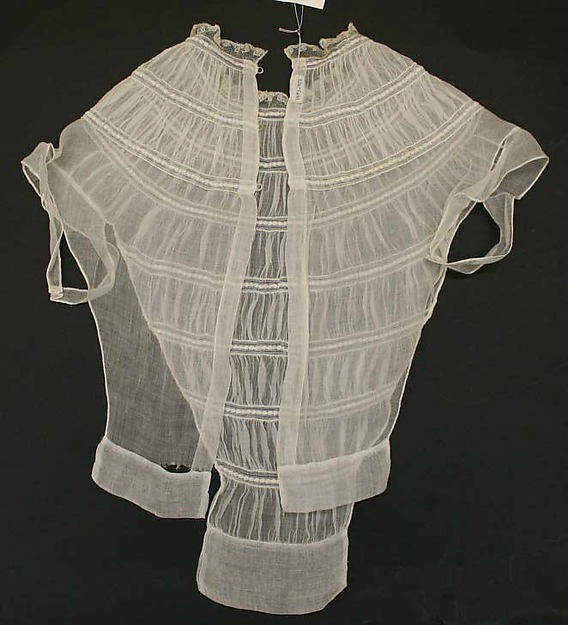
Materials used for the chemise varied from fine linen, holland, and cambric to cotton, and silk. Depending on the neckline of the dress, the chemise could have a high neckline with embroidery, lace or ruffles, or a low neckline that was not meant to be seen. They were almost always white. Sleeve and hem length also varied as the style of women's dress changed through out history. Some extant examples show bobbin lace or embroidery all the way down to the waist or along the seams to act as reinforcement. Sometimes they were heavily perfumed to help cover body smells or the smells from the laundering process.


Related image
                                                                                    Chemise pattern 

The chemisette was a "little chemise" used to fill in the neckline of a gown without the added bulk of a full chemise. 

Image result for chemisette
                                                                                       Chemisette

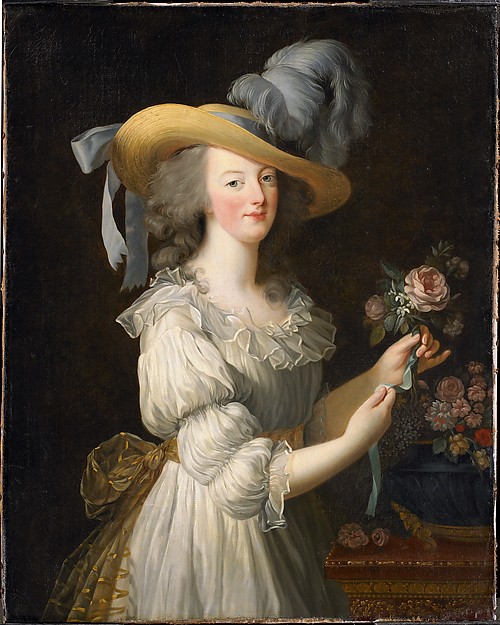
Queen Marie Antoinette of France shocked genteel society by allowing herself to be painted in a Chemise dress. This dress, also called chemise a la reine or gualle, was such a contrast to the normal attire of constricting, large hooped dresses worn at the French court. These dresses were made of light, gauzy muslin, tied with a sash around the waist and gave the impression that the wearer was in hardly more than her undergarments! These dresses were so thin that they garnered the nickname the Influenza Dress.

Marie Antoinette in a Chemise Dress, Élisabeth Louise Vigée Le Brun (French, Paris 1755–1842 Paris), Oil on canvas
                 Marie Antoinette in Chemise Dress Oil on canvas 1783 Élisabeth Louise Vigée Le Brun

The chemise took on many styles such as the princess chemise, or the empire chemise with a sloping front waist and puffy short sleeves. In 1877 a new style of combining a chemise and drawers together came on the fashion scene making the basic chemise outmoded. This garment could have a back or front opening and were worn to obtain the desirable female figure. By the mid 1900's the chemise was shortened into a vest-like garment but retained its original name. Also by this time it was no longer being worn as sleep wear. Separate garments known as pyjamas were the commonly worn clothing attire to sleep in.  

Today a modern chemise is still typically an unfitted, loose flowing women's undergarment. Chemise dresses are still in fashion as well and basically have the same form and function.
Image result for chemise


Further reading:

The History of Underclothes - C.Willett and Phillis Cunnington

Clothing Through American History: The Federal Era -Antebellum 1786-1860 - Ann Buermann Wass and Michelle Wenn Fandrich


Sunday, March 1, 2015

Suffragettes of Tennessee

"Bullets and ballots are not companions, but ballots in the hands of people are supposed to be a substitute for bullets in the hands of hired agents...Thanks be to God that in giving women the crown of motherhood he made her the giver not the taker of life. Woman has no greater claim to the rights of the ballot than she is a producer not a destroyer of life." - Lizzie Crozier French


                                                       Suffrage Poster


Everyone knows of the tireless efforts of women like Susan B. Anthony, Alice Paul, Lucretia Mott, Carrie Chapman Catt and Elizabeth Cady Stanton in their fight for the right for women to vote. Their names have become synonymous with Women's Suffrage. Few people have heard of these remarkable Tennessee women that helped convince the Tennessee Legislature to ratify the Susan B. Anthony bill; known today as the 19th Amendment to the Constitution. 

 In order for an Amendment to pass and become law it has to pass through both houses of Congress and then be ratified by a majority of 36 states. In 1919, the 19th Amendment passed through both houses of Congress. Six states ratified the bill immediately. Twenty nine states soon followed suit while six Southern states rejected it. Florida, North Carolina, Vermont, Connecticut, and Louisiana opposed the Amendment. The last two states to decide were Delaware and Tennessee. When the bill was defeated in Delaware every breath was held and every eye turned to Tennessee. 

                                                  Anti-Suffrage Poster


Tennessee had it's own "War of the Roses" as anti-suffragists campaigned using a red rose to symbolize their stance and suffragists choosing a yellow rose. Nashville was flooded with campaigners and lobbyist. On August 9, 1919 a special session of the Tennessee General Assembly was called; requested by Sue Shelton White. The bill finally passed the Senate on Friday, Aug. 13 by a margin of 25-4 with one senator abstaining. The bill was then handed off the the House where it was debated for three more days. A test vote to table the resolution lost on a 48-48 tie and, knowing another tie vote would defeat the bill  an anti-Suffragist immediately called for another vote to kill the amendment in Tennessee. Rep. Harry Burn, after having just received a letter from his mother urging him to ratify, voted "Aye" to the resolution The bill now had a 49-47 majority in the Tennessee House of Representatives.  On August 18, 1919, Tennessee certified the ratification, becoming the 36th state to do so and making the 19th Amendment to the United States Constitution the law. Women everywhere celebrated their win. They now had the right to vote! 


Tennessee was an important factor in deciding the fate of American Women and so were these ladies that you, dear readers need to know about. There were many women in the state that came together to make their voices known. History has not left us with the names of every Tennessee suffragist but we remember their collective effort to support the cause. Now I would like to introduce you to the following remarkable Tennessee Suffragettes.


                     The Tennesee Woman's Suffrage Memorial depicts Lizzie Crozier French, Anne Dallas Dudley, and Elizabeth Avery Meriwether. The three women represent the three different regions of Tennessee. It is located in Market Square Mall, downtown Knoxville, TN


Anne Dallas Dudley 
"Every reform is started by a minority."
Anne was from a wealthy family in Nashville. Anne Dallas Dudley, daughter of Trevanion Dallas, a wealthy cotton mill owner, and great niece of George Dallas, who was James K. Polk's vice president.  She was a strong believer in the Woman's Suffrage Movement. Anne shocked all of the Nashville elite by organizing the first suffrage parade not only in Nashville, but in the South. Sixty automobiles, decorated with yellow banners, paraded from the Capitol to Centennial Park. To counter the criticism that suffragists ignored their families, Anne Dallas Dudley was joined in the lead car by her husband, Guilford Dudley, co-founder of Life & Casualty Insurance Co., and their children. She helped found the Nashville Equal Suffrage League in 1911 and convinced Susan B. Anthony to hold the national conference for her American Woman Suffrage Association at the Ryman Auditorium in Nashville. In the 1930s Dudley served as president of the Maternal Welfare Organization of Tennessee. This group brought birth control pioneer Margaret Sanger to Nashville in 1938 to increase public awareness of birth control. She is buried at Mt. Olivet Cemetery in Nashville.


Sue Shelton White
"We should be ashamed to stand on ground won by women in the past without making any effort to honor them by winning a higher and wider field for the future."
"Miss Sue" as she was called, was born in 1887 and grew up and lived in Henderson, a suburb of Nashville. Unlike most suffragettes, her parents were both teachers and they lived very modestly. Left an orphan at the age of 14, Sue vowed to pursue an education so she would not become anyone's financial responsability. She moved in with her aunt and enrolled in George Robertson Christian College and then went on to study at West Tennessee Business College. In 1907, Sue became one of 
the first female court reporter in Tennessee. In 1912, while living in Jackson, TN, Sue became a founding member of the Jackson League of the Tennessee Equal Suffrage Association (TESA) and was elected recording secretary the following year. She wavered back and forth between the two different Suffrage organizations; the NAWSA (The National American Woman's Association) and the NWP(National Woman's Party). She was elected chairwoman of the Tennessee chapter of the NWP after breaking ties with the NAWSA for good. In 1919, she was elected as editor of the NWP;s newspaper Suffragist. After the radification of the 19th Amendment which finally gave women the right to vote, Sue moved to Washington. D.C. to pursue a law degree. In 1923 she recieved her degree and was admitted to the Bar. She continued to fight for women's equality and helped draft the Equal Rights Amendment. In 1926, Sue moved to Jackson TN and became the city's first female lawyer. Sue is the only known female Tennessean who was jailed for her participation in the suffrage cause. She was a member of the NWP protest party that burned an effigy of President Wilson in front of the White House. She died in 1943 from cancer.

Lizzie Crozier French 
Lizzie Crozier was born in Knoxville on May 7, 1851 to Congressman and local attorney John H. Crozier. While little information is known about her mother, Lizzie was one of three girls born into the family. Lizzie was educated at the Convent of Visitation at Georgetown in Washington, D.C. and at a private Episcopal School in Columbia, TN. Lizzie married William French at age 21 and together they had a son. William died after only two years of marriage and Lizzie took a teaching position at the Knoxville Female Academy. In 1885, Lizzie French, along with her sisters Lucy and Mary founded a school for "young ladies and children" at the Knoxville Female Academy, where the sisters developed an educational curriculum that taught children more than just the basics of reading and writing. They did so well that the school became known throughout the city and was one of the most popular among parents and students for its approach to education. 
On Nov. 20 of that same year, French invited 12 women to the Knoxville Academy to organize a literary group like the one she had visited while traveling in New York. The 12 women who chartered the organization that night chose the name the Ossoli Circle. In 1896, French founded the Women’s Educational and Industrial Union and used her position in the organization to become the first 
woman to address the Knoxville City Council appealing for the appointment of a Police Matron– a female police officer for women offenders who would assist in the care and treatment of the females arrested by police. She convinced the City Council of the need for one and filled the position herself for several months until the city could hire someone permanetely. She then became the first woman to address the Tennessee General Assembly, lobbying on behalf of efforts to establish a separate prison for women and children in the state of Tennessee, which led to the establishment of both institutions. In 1912, Lizzie was elected president of the Tennessee Suffrage Association. She also became the first woman to address the Tennessee Bar Association. French continued her work in Knoxville founding and serving as president of the Knoxville Equal Suffrage Society and becoming a leading member of the National Women’s Party(NWP). On Aug. 9, 1919, the special session of the Tennessee General Assembly was called to order. Lizzie, then 68 years old, was there using her voice. Lizzie remained an active member of the Knoxville community and made a bid for City Council in 1923, but was defeated. Three years later, at the age of  75, she traveled to Washington, D.C. to help the National Women’s Party furnish a room in honor of the Tennessee suffragists and also secure introduction of a bill in Congress to benefit working women in America. On May 14, 1926, while still in D.C., the Tennessean quietly passed away. Her body was returned to her hometown in Knoxville where she was laid to rest in the city’s Old Gray Cemetery.


Elizabeth Avery Meriwether
 “But when will women have the right to vote?  I have been taught to believe that taxation without representation is tyranny.”
Elizabeth was born in Bolivar, TN in 1824. Her father was a Quaker physician and her mother was the daughter of a Virginia planter who had moved to Tennessee. Elizabeth's parents died when she was 22. She and her siblings lived in poverty until her brother Tom finally received his law degree. In January 1850, Elizabeth married Minor Meriwether, a civil engineer. He later joined the Confederate Army to fight for the South in the War Between the States. Elizabeth found her name on a list of outspoken Confederate officer's wives who were to be removed from their homes near Memphis or face arrest and incarceration. Elizabeth had two small children and was pregnant with her third. She attempted to follow her husband's unit, and delivered her third child in a stranger's house on Christmas night in 1862. She resorted to stealing corn for food for her children, selling clothing and even sneaking back into Memphis on a dangerous mission to pay taxes so her property would not be sold at auction. She eventually ended up in Tuscaloosa, Alabama. During this time she began writing stories and selling them to newspapers. After the war Minor Meriwether purchased a modest Memphis home for his family on the current site of the Peabody Hotel. Elizabeth petitioned occupation forces under Union General Stephen A. Hurlburt, in an effort to regain title to her girlhood home which had been confiscated by the Union during the war, and was finally successful. Thus recognized as a property owner and tax payer, she obtained a voter registration in 1872. In 1876 she went to the polls and attempted to vote in the presidential election of that year. (At this time I have not verified whether she was actually allowed to vote. It was rumored that they dropped the ballot in the box to keep her happy and then destroyed her ballot later. ) She was one of the first women in the state to publicly push for women's suffrage in the early 1870s. She wrote letters to newspapers and published a pamphlet about women's rights. For a year, she published a small newspaper, The Tablet, which showcased her views on women's issues, divorce law and equal pay for women teachers. In 1876 she made one of the first public suffragist speeches in Memphis. She was active in the Women's Christian Temperance Union and belonged to the National Woman Suffrage Association, and presented unsuccessful women's suffrage petitions at both the Democratic and Republican national conventions in 1880. In 1881, Meriwether joined Elizabeth Cady Stanton and Susan B. Anthony on a speaking tour. She also continued to write, publishing several books. In the late 1800s, the Meriwethers moved to Saint Louis, Missouri where they built Meriwether Mansion. Just before her death on November 4, 1916, Elizabeth wrote her memoirs entitled Recollections of 92 years. She did not live to see the 19th Amendment become law. She is buried in  Bellefontaine Cemetery in St. Louis.


                                                                 Suffrage Parade


Mary Cordelia Beasley Hudson
Mary was the first woman to legally vote in Tennessee. Mary was born in Benton, Co. TN on August 1, 1851. She was the daughter of Reuben Beasley and Elizabeth Brown.  On January 9, 1872, she married O. B. C. Hudson in Benton County.  She and her husband had six children and operated a grocery store near their home in Camden, TN. On April 5, 1919, the Tennessee General Assembly passed a limited suffrage act. Governor Albert H. Roberts signed the suffrage bill into law on April 17, 1919.  A few days following this, on Tuesday, April 22, a municipal election was held in Camden.  Mrs. Hudson, who had joined the suffrage movement in 1918, cast her vote and was quick to point out that she voted for the winner of the election, A. V. Bowls. I have not been able to find out much more than this but I will continue to research.


Further Reading:
The Woman Suffrage Movement in Tennessee - Antoinette E. Taylor
More than Petticoats: Remarkable Tennessee Women - Susan Sawyer
The Perfect 36: Tennessee Delivers Woman Suffrage - Carol Lynn Yellin and Janann Sherman
Recollections of 92 Years - Elizabeth Avery Meriwether
One Woman, One Vote; Rediscovering the Woman Suffrage Movement - ed. Marjorie Spruill Wheeler. Troutdale, OR: NewSage Press 1995
Votes for Women!:The Woman Suffrage Movement in Tennessee, the South, and the Nation - Knoxville, TN: University of Tennessee Press 1995
http://tennessee.gov/tsla/exhibits/suffrage/beginning.htm
National Women's History Museum